
Why e-learning cannot work the same for all target groups
In many companies, those responsible for learning face the same challenge: a topic is strategically relevant and affects everyone - but the target groups differ significantly. Managers have different expectations of corporate e-learning than employees, take on different roles and make different decisions in their day-to-day work.
Traditional e-learning formats quickly reach their limits, especially when it comes to value-based topics such as diversity and inclusion. Simply imparting knowledge is not enough. Target group-oriented e-learning with gamification must address behaviour, attitude and decision-making in equal measure.
Gamification as the key to target group orientation
Gamification in corporate learning is much more than points, badges or rankings. Used correctly, it creates emotional involvement, promotes a change of perspective and makes abstract content tangible. The decisive factor here is a customised focus on the respective target group:
-
What role does the target group play in the learning setting?
-
What decisions does it make in its day-to-day work?
-
What consequences should be made tangible?
The "Building Inclusion at STRABAG" project, which X-CELL developed together with the international construction group, is an excellent example of this.
Best practice: Two target groups, two learning worlds - one common goal
STRABAG was faced with the task of bringing the company-wide EDI strategy to life for more than 86,000 employees from 155 nations. It quickly became clear that a single learning format would not do justice to this diversity.
The solution: two independent e-learning programmes, each with its own gamification logic, tailored to the specific roles of managers and employees.
E-learning for managers: making responsibility tangible
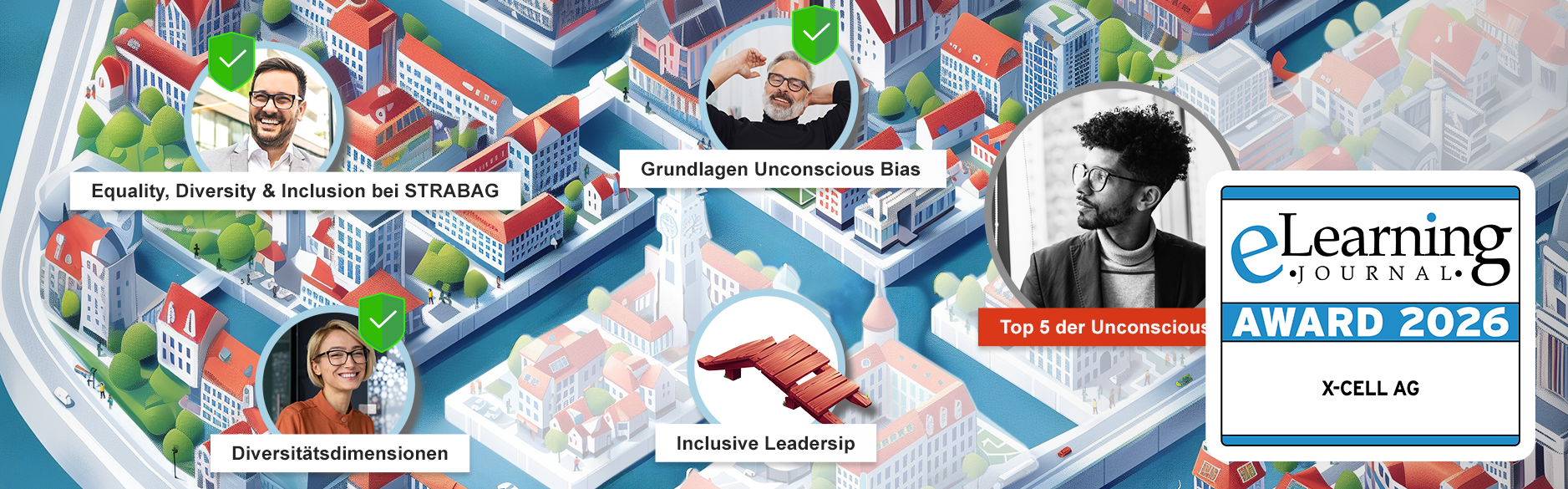
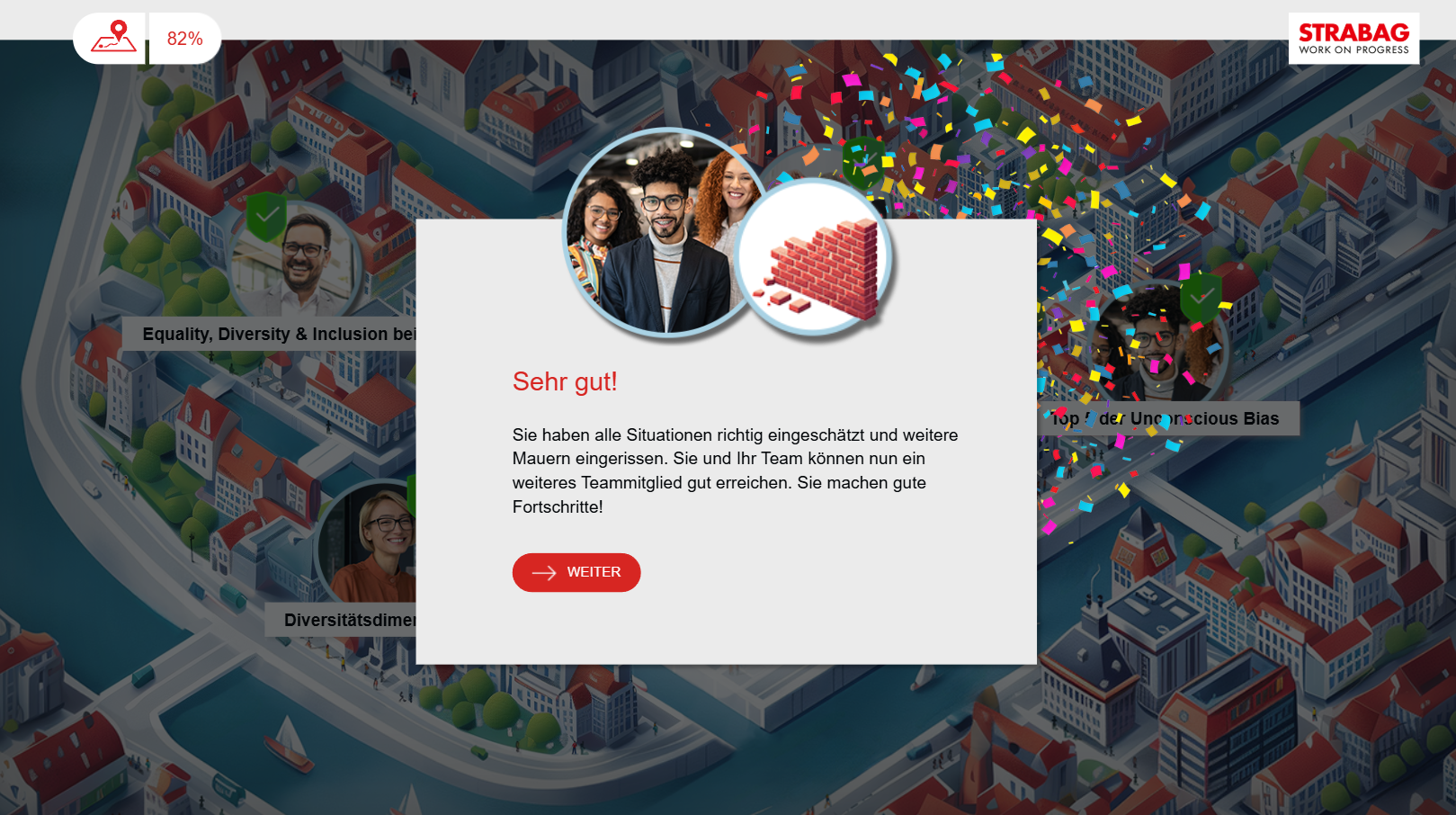
The e-learning programme for managers focuses on responsibility, leading by example and decision-making. In a virtual city, managers experience barriers and bridges as metaphors for real challenges in day-to-day management.
The task: to break down barriers in order to create connections between team members.
Gamification creates a safe space for reflection: decisions have a direct impact and inclusive behaviour can be experienced immediately.
E-learning for employees: Experience diversity in everyday project work
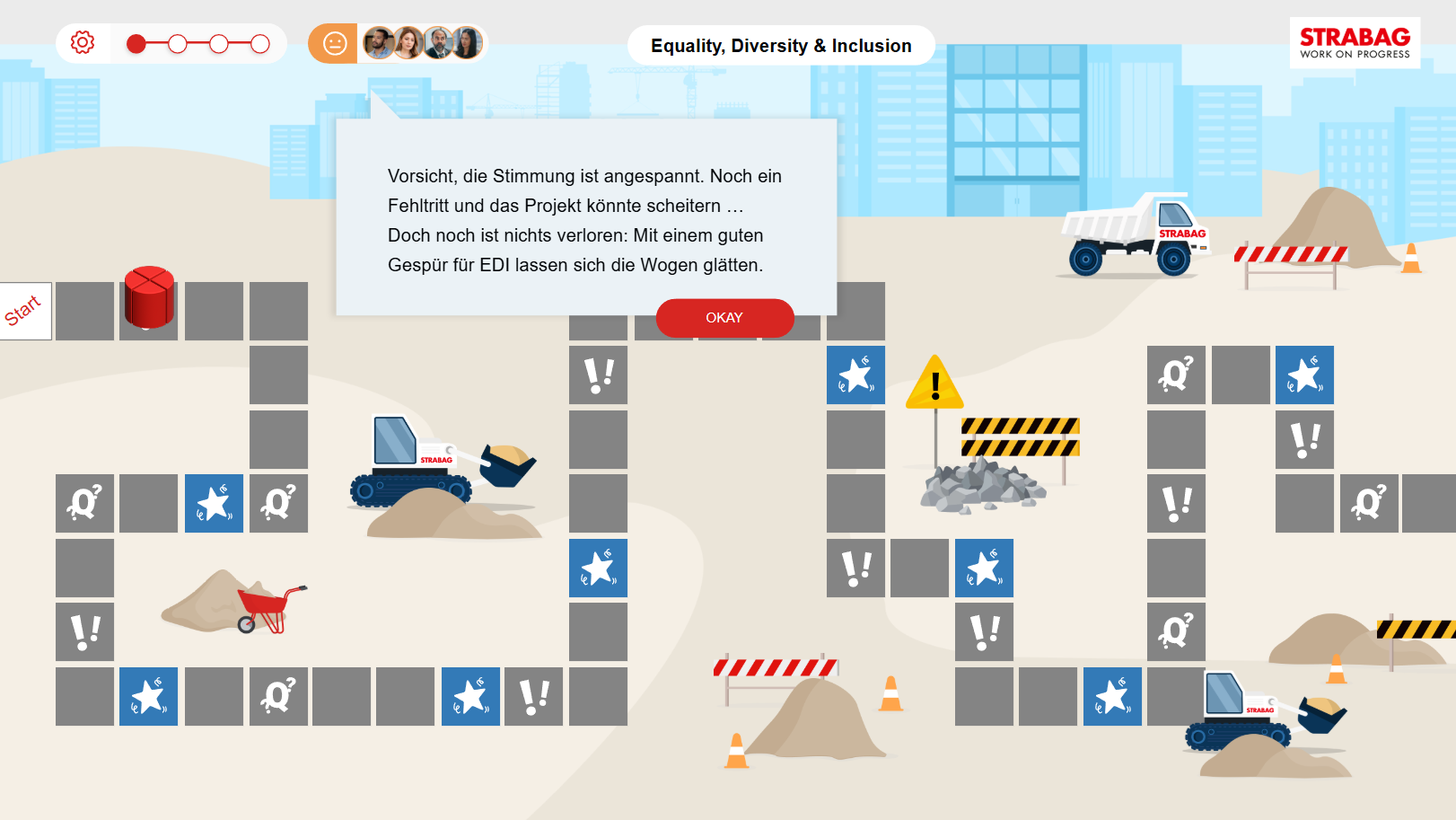
The e-learning programme for employees is based on a gamified project scenario: on the "construction site of diversity", learners accompany a project team through various phases of a construction project.
Every decision influences team cohesion:
-
Respectful communication strengthens the project,
-
Misunderstandings and prejudices cause it to falter.
Gamification in e-learning makes abstract content concrete and transferable to everyday working life.
Why the approach works - didactic success factors for effective corporate e-learning
The success of the project is based on clear didactic principles:
-
Target group-specific storytelling instead of generic content
-
Scenario-based learning that reflects real-life situations
-
Interactive decision-making mechanics
-
Clearly structured learning units
-
High visual quality and intuitive user guidance
The result: high acceptance, strong motivation to learn and measurable impact. Even in the pilot phase, the training courses achieved over 500 ratings with an average of 4.5 out of 5 points, and the participation rate among managers was almost 100 per cent.
Award as proof of quality: eLearning AWARD 2026
The innovative use of storytelling and gamification did not go unnoticed. The "Building Inclusion at STRABAG" project was honoured with the eLearning AWARD 2026 in the Storytelling - Focus on Diversity & Inclusion category.
The jury particularly recognised
-
the clear target group orientation,
-
the courage to use playful learning formats in a traditional environment
-
and the sustainable combination of learning, attitude and corporate culture.
Conclusion: Target group-orientated e-learning with gamification has a lasting effect
The project is an example of how e-learning with gamification must be designed in order to reach different target groups effectively.
If you want to organise learning effectively, you have to take target groups seriously, understand their perspectives and offer them learning spaces in which they can find themselves. Gamification and storytelling provide the right tools for this - if they are used strategically, didactically sound and consistently user-centred.