

AI has arrived in everyday corporate life - the legal framework is following suit
AI tools such as ChatGPT, Copilot and Midjourney have long been an integral part of many work processes. Whether in marketing, text processing or customer service - artificial intelligence supports millions of employees every day.
However, rapid technological progress also brings with it new risks. Uncontrolled use can present companies with legal, organisational and ethical challenges:
Confidential information is entered into chatbots, results are accepted without verification or AI systems are used in areas for which they are not designed.
At the same time, there is growing concern that AI systems are increasing discrimination or being misused to monitor employees - for example in automated performance evaluations or in personnel selection.
With the EU AI Act, the EU is responding to these developments and creating a standardised legal framework for the use of artificial intelligence for the first time.
What does the EU AI Act regulate and to whom does it apply?
The EU AI Act categorises AI applications into different risk classes - from minimal to unacceptable. The higher the risk, the stricter the requirements. The focus is particularly on so-called high-risk systems, for example AI in personnel selection and assessment or in the healthcare sector.
However, the AI Act also requires companies to use AI in a responsible, transparent and controllable manner for less risky applications.
One key element is that employees must have a basic understanding of how to use AI. This is where training comes into play.
Training obligations in the EU AI Act - what do companies need to consider?
The EU AI Act stipulates that companies must ensure that employees who work with AI systems have sufficient knowledge and skills. This applies not only to people who select or introduce AI systems, but to all employees who work with AI applications or use their results.
This does not mean that everyone will become an "AI expert". It is crucial that employees are aware of the basic risks and framework conditions: They should know that AI decisions can be flawed or biased, that transparency and documentation obligations apply and that humans retain ultimate responsibility.
Training for employees is therefore no longer just "best practice", but an essential building block for fulfilling the legal requirements.
Learn more about our AI training product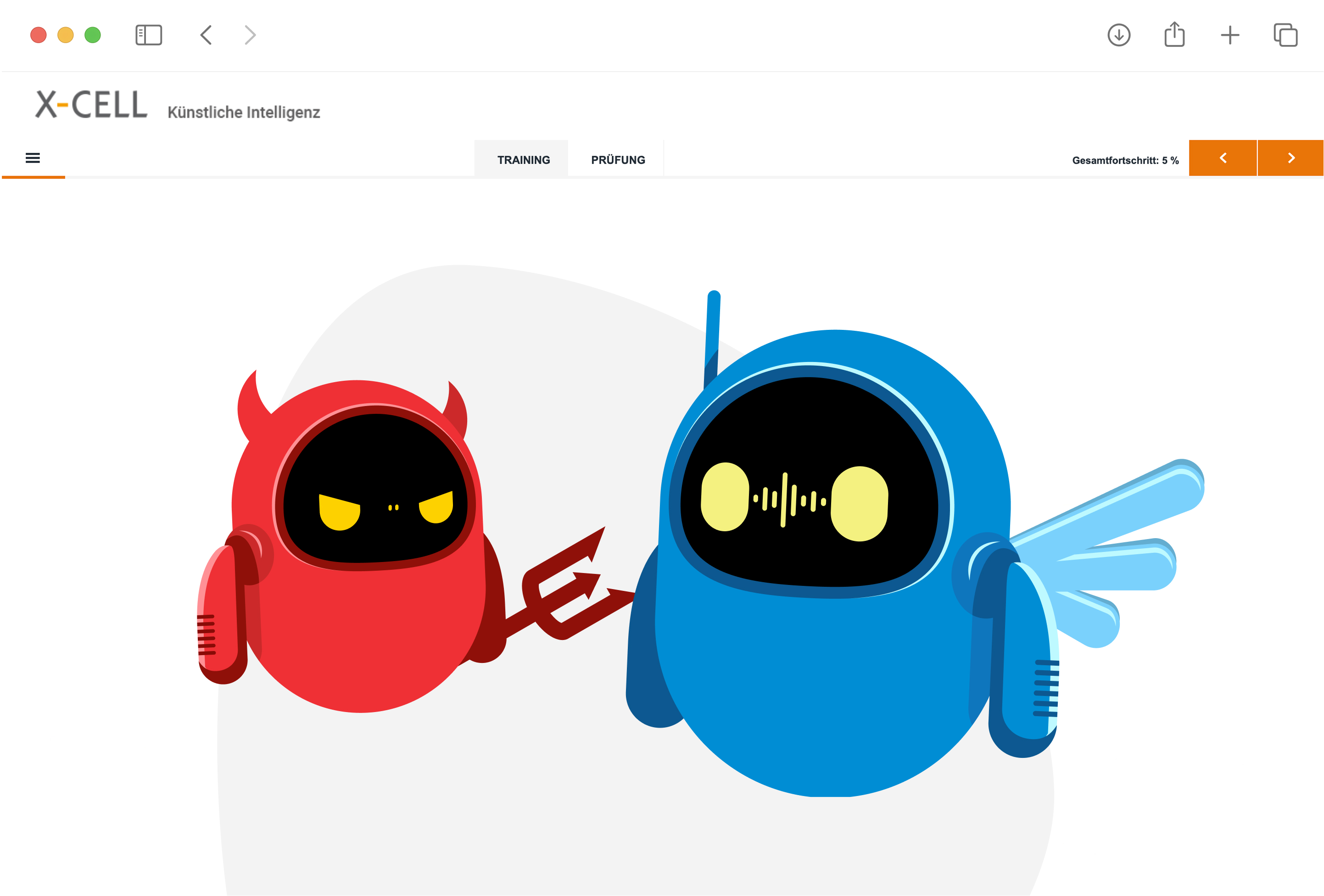
Typical risks - and what legally compliant AI training should cover
In practice, similar patterns emerge time and again when employees are not sufficiently trained:
-
Uncritical adoption of AI results
Decisions are made on the basis of AI suggestions without checking them or comparing them with other sources. -
Biased decisions (bias)
AI systems that have been trained on historical data can perpetuate existing disadvantages - for example when selecting staff or granting loans. -
Non-transparent processes
Employees can hardly explain to applicants, customers or supervisory authorities how an AI-supported decision was made. -
Lack of contradiction
If AI is perceived as "objective", many people are afraid to question decisions - even though this is exactly what the EU AI Act requires.
This is precisely where EU AI Act-orientated AI training comes in: It makes these risks visible, categorises them in legal terms and shows how employees can handle AI responsibly on a day-to-day basis. This turns an abstract law into a concrete framework for the use of AI in day-to-day business.
E-learning as a building block for AI compliance
For training courses to have a lasting effect in the company, they must be scalable, up-to-date and comprehensible. This is where e-learning comes into its own: They reach distributed teams regardless of time and place, can be easily updated to meet new requirements and enable clean documentation of participation, progress and learning success - an important aspect for proof of compliance. Practical examples, interactive elements and comprehension checks also help to embed what has been learnt in everyday working life.
It is particularly efficient when companies rely on ready-to-use and legally certified AI training courses: they do not have to design, coordinate and continuously review content themselves, but can rely on ready-made, certified learning modules - and are still on the safe side legally. It remains important to ensure continuous updating: The legal framework is developing rapidly, especially in the field of AI and regulation. Training concepts that are regularly updated and adapted to new requirements have a clear advantage here.
In this way, training becomes a strategic building block of AI governance rather than an annoying obligation: companies show that they take their responsibility seriously, create transparency towards supervisory authorities and at the same time strengthen confidence in the use of AI in their own organisation.
Conclusion - take the EU AI Act seriously, use training strategically
The EU AI Act is changing the way companies think about AI: away from experimental stand-alone solutions and towards structured, traceable and responsible use of AI.
Training is not a side issue, but a key tool for understanding risks, clarifying roles and responsibilities and being able to demonstrate this in an emergency: "We have prepared our employees."
If you want to use AI in your company, there is no way around systematic training.