

Seminars, training and further education programmes are an integral part of many companies' HR strategy. At the same time, the requirements for organisation, documentation and transparency are increasing. At the latest when several formats, target groups or locations come together, it becomes clear that structured seminar management can hardly be realised efficiently without software.
However, not every seminar management software is suitable for today's corporate requirements. Many organisations are still struggling with outdated systems, confusing user interfaces and fragmented tool landscapes or isolated solutions.
What is seminar management software?
Seminar management software supports companies in the planning, organisation and evaluation of further training measures. It maps administrative processes - from scheduling and participant management to the documentation of qualifications.
In the corporate context, this is less about selling and invoicing seminars and more about:
-
Internal qualification
-
Compulsory training
-
Strategic personnel development
-
Transparent evidence for management or supervisory bodies
-
Booking and approval processes that take the company hierarchy into account
The problem of classic seminar management
Many seminar management systems established on the market date back to a time when digital training was thought of differently. Moreover, they were originally designed for training providers, not for companies. Accordingly, typical weaknesses are evident today:
-
Outdated and confusing user interfaces
-
Low user-friendliness and high complexity
-
Rigid structures that are difficult to adapt to modern learning formats
-
High complexity and many functions that are unnecessary for further training in the company
There is also another key problem: traditional seminar management systems are often isolated solutions. A separate learning management system (LMS) is also required for online training or e-learning. In order to avoid duplicate data maintenance and media disruptions, interfaces must be created or set up. A complete overview of qualifications is missing or is not part of the software.
Why companies need holistic solutions today
The training landscape in companies has changed significantly. In addition to traditional face-to-face seminars, webinars are now a matter of course:
-
webinars
-
Online training
-
External qualifications (face-to-face or online)
-
Blended learning concepts (combination of face-to-face and online learning)
Modern seminar management software must be able to map all these formats in one system. This is the only way to create a centralised view of employee qualification levels. Furthermore, the focus must be on efficiency, organisation and documentation, and HR and compliance processes must be optimally supported.
Key requirements for modern seminar management software
From a company perspective, this results in clear requirements:
-
Centralised management of all event formats
Face-to-face events, webinars, online training and external qualifications are organised uniformly. -
Intuitive user interface
Modern software must be easy to understand without lengthy training sessions - for HR, specialist departments and participants. -
Holistic overview
All measures, participation and qualifications are documented in one place. -
Automation & efficiency
Invitations, registrations, reminders and analyses are largely automated. -
Flexibility & future-proofing
Individual requirements can be integrated.
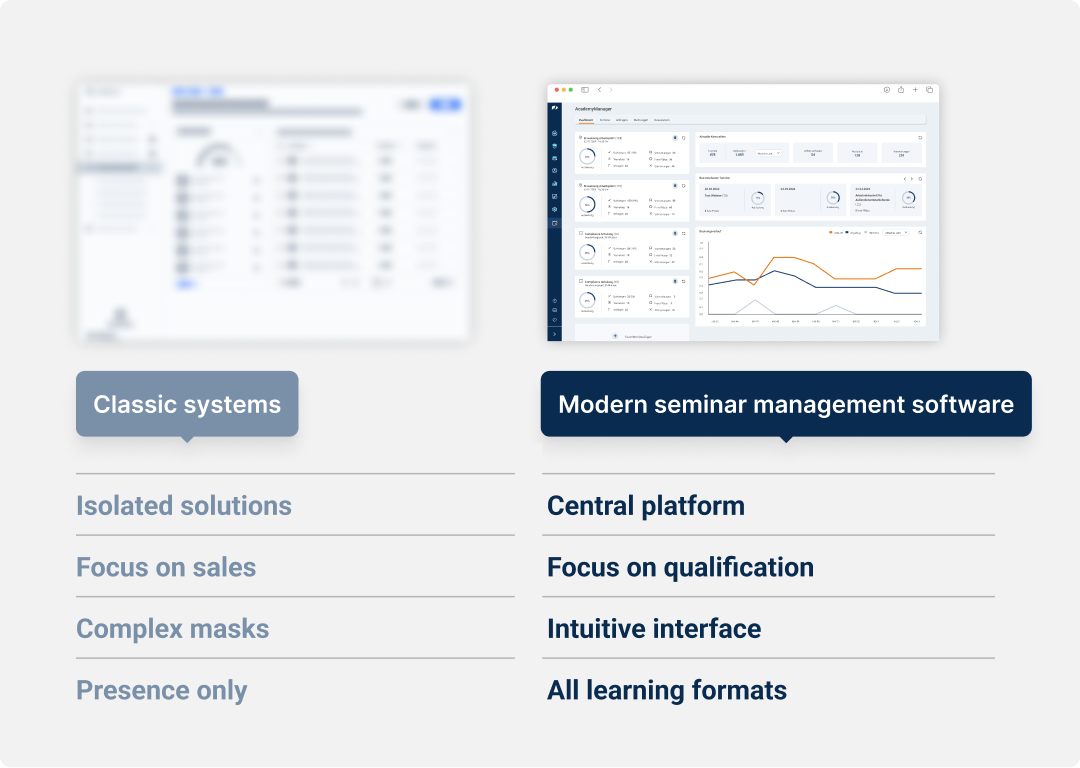
Modern seminar management needs modern software
A major advantage of current solutions is that seminar management and online training no longer have to be considered separately. Companies benefit when:
-
face-to-face seminars and webinars are treated equally in organisational terms
-
Online training is directly integrated into seminar planning
-
External qualifications are also documented centrally
This results in consistent training management - without additional interfaces or parallel systems.
When is the switch particularly worthwhile?
Switching to a modern seminar management software is particularly useful when:
-
Existing systems are technically and visually outdated
-
Several tools are used in parallel
-
Excel lists have to replace the overview
-
Communication with participants still takes place by telephone and email
-
Learning and event formats are increasingly merging
Growing companies in particular benefit from a solution that is designed for scalability and integration from the outset.
Conclusion
Today, seminar management software is far more than just an organisational tool. Companies need solutions that are user-friendly, integrated and flexible - and that combine all learning and event formats in one system.