

Global supply chains under pressure
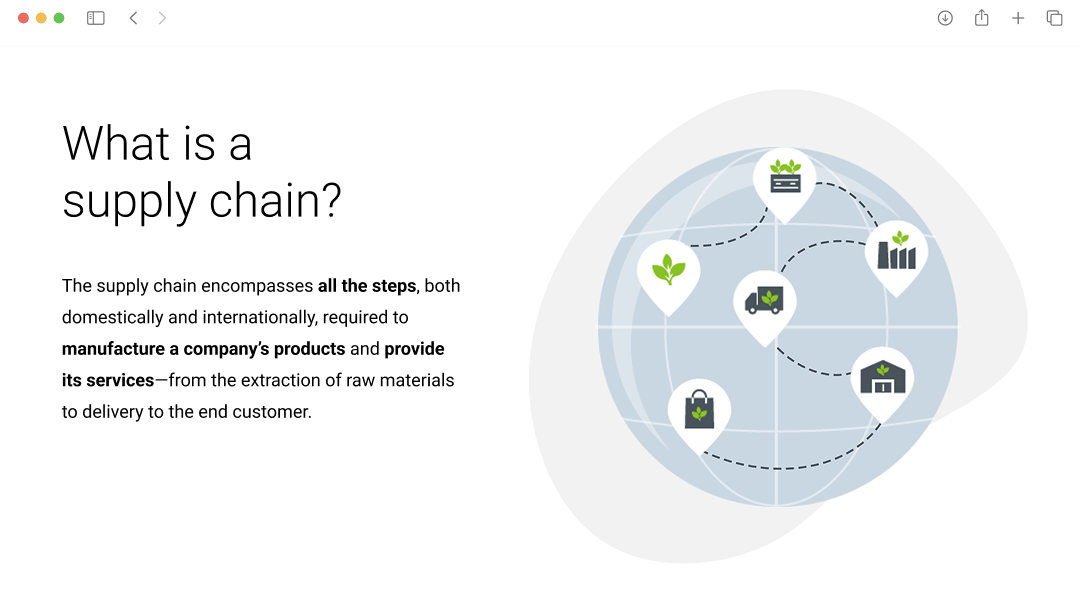
International supply chains are complex, ramified and often difficult to penetrate. Raw materials, preliminary products and services often come from regions where labour and environmental standards are not always observed.
This is precisely where legal regulations come in: They oblige companies to take responsibility for their supply chain - with graduated due diligence obligations that are based on potential influence and risk situation.
The German Supply Chain Due Diligence Act (LkSG) and the planned EU Supply Chain Directive (CSDDD) will make this responsibility increasingly binding.
What does the Supply Chain Act regulate - and to whom does it apply?
The German Supply Chain Act has applied to large companies with a registered office or branch in Germany since 2023. Since 2024, the scope of application has been extended to companies with at least 1,000 employees.
Essentially, the law obliges companies to identify, assess and minimise human rights and environmental risks along their supply chain. This includes, among other things:
-
Prohibition of child labour and forced labour
-
Protection against discrimination and exploitation
-
Compliance with labour protection standards
-
Environmental due diligence obligations
In addition, companies must establish preventative and remedial measures, facilitate complaints procedures and document their activities.
At the same time, there are signs of political relief: A current draft bill plans to reduce bureaucratic requirements in particular - for example by removing the public reporting obligation and focussing sanctions more on serious violations.
However, these adjustments do not change the core of the regulation. The substantive due diligence obligations remain in place, as does the responsibility of companies to actively recognise and manage risks.
At EU level, the planned Corporate Sustainability Due Diligence Directive (CSDDD) goes one step further. It is intended to standardise the requirements across Europe and expand them in the future - even if recent political discussions have led to possible relaxations and postponements.
This creates an area of tension for companies: in the short term, the bureaucratic burden will be reduced - at the same time, new requirements are already being announced at EU level, which companies should prepare for at an early stage.
One thing is clear: the direction remains the same - companies must analyse their supply chains in a structured manner, assess risks and implement suitable measures in a comprehensible manner.
Challenges in practical implementation
The basic requirements are clear - but implementing them in day-to-day business is often challenging. Supply chains extend across many stages, information is incomplete and risks are not always recognisable at first glance. Indirect suppliers in particular often lack the necessary transparency.
What's more, responsibility does not lie solely with the compliance department. In many areas - such as purchasing, supplier management or quality assurance - employees make decisions on a daily basis that have a direct impact on compliance with due diligence obligations.
Without a common understanding of what to look out for, uncertainties can quickly arise. Risks are overlooked, misjudged or not consistently addressed. This is precisely where it becomes clear that processes and guidelines alone are not enough.
Why knowledge about human rights is becoming a success factor
In order for companies to fulfil their obligations effectively, employees must know and be able to classify the relevant risks. It is important to understand how human rights violations occur in the supply chain, what warning signals there are and how to react in specific cases.
This knowledge is not a theoretical supplement, but a key prerequisite for the effective implementation of due diligence obligations. After all, only if employees are sensitised can risks be identified at an early stage and appropriate measures initiated.
At the same time, a sound understanding of human rights also improves the quality of everyday decision-making - for example when selecting suppliers or dealing with anomalies.
E-learning as an effective lever for supply chain compliance
Structured and scalable training solutions are needed to build up this knowledge throughout the company. This is precisely where e-learning comes into its own: They make it possible to sensitise employees to the requirements of the Supply Chain Act in a targeted and efficient manner - regardless of location or function.
Well-designed e-learning courses not only teach the basics, but also translate legal requirements into specific situations. They show in a practical way what is important in everyday working life and help to reduce uncertainties. At the same time, training courses can be documented and easily updated in the event of new regulatory developments.
This turns a complex legal requirement into a comprehensible and realisable part of day-to-day work.