
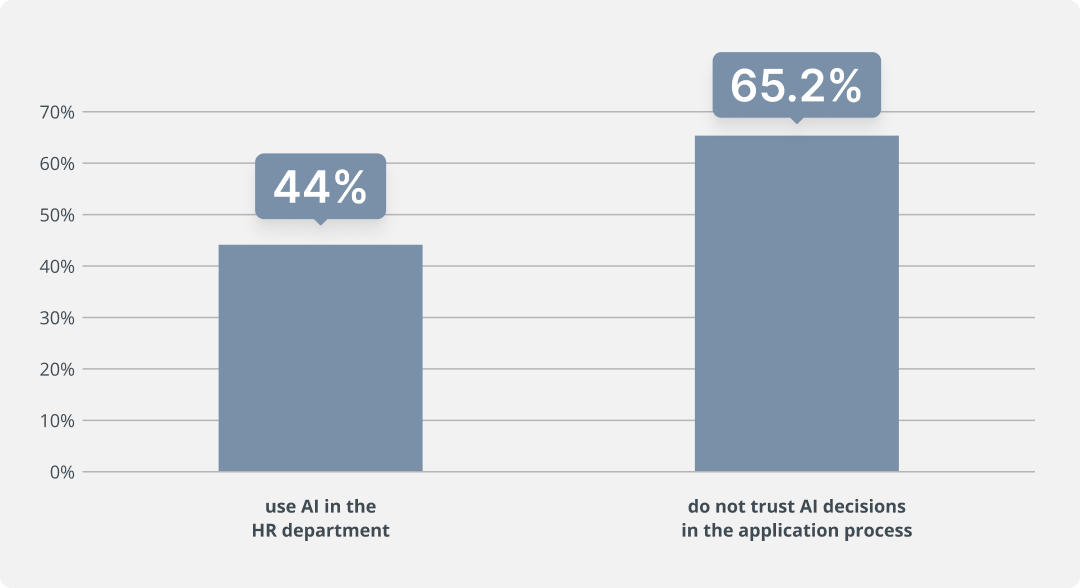
Artificial intelligence is increasingly finding its way into HR processes. According to a survey by ManpowerGroup, 44 per cent of German companies already use AI in areas such as recruitment, onboarding and training. A further 23 per cent are planning to introduce it within the next twelve months.
At the same time, a study by IU International University shows that 65.2 per cent of respondents do not trust AI-supported decisions in the application process. Furthermore, 80.5 per cent feel less valued when an AI, rather than a human, decides on their application.
This discrepancy makes it clear that the more companies use AI, the more important transparency, fairness and the responsible management of potential discrimination risks become.
Why AI is not automatically fair
It is often assumed that algorithms make neutral decisions. In reality, however, AI systems are based on data – and this data often reflects existing societal or internal corporate patterns. If training data is unbalanced or contains historical instances of discrimination, the AI may adopt or even reinforce these. This phenomenon is known as bias.
Bias can arise not only from training data, but also from the way in which AI systems are developed, deployed or monitored. Bias is therefore not merely a technical problem, but also an organisational and human challenge.
For example: if an AI system is trained using recruitment data from which predominantly men were hired in the past, the system may unconsciously favour male applicants. Similar risks exist in promotion decisions, performance appraisals or the automated pre-selection of applications.

Discrimination caused by AI remains the responsibility of the company
Even if a decision is prepared or made by an AI system, responsibility still lies with the company. Employers cannot claim that the software made the selection.
If discrimination occurs on the basis of a legally protected characteristic – such as gender, age, ethnic origin, religion or belief, disability or sexual identity – claims may arise under the General Equal Treatment Act (AGG). In addition, there is a risk of reputational damage, a loss of trust and – depending on the area of application – regulatory requirements under the EU AI Act. For example, this classifies AI systems used in recruitment or for personnel decisions as high-risk AI and imposes specific requirements regarding transparency, data quality and human oversight.
Areas where businesses should be particularly vigilant
Not every AI application carries the same level of risk. Systems that prepare or influence decisions affecting people are particularly sensitive, for example in the following areas:
recruitment and applicant management
Staff development and promotions
Performance appraisals
Shift or resource planning
Allocation of further training opportunities
Customer service or automated communication
The more AI systems are used to prepare or influence HR decisions, the more important transparency, human oversight and regular checks for potential biases become.
What businesses should be doing now
Companies do not need to avoid AI – but they should use it responsibly. This includes, amongst other things:
Regularly reviewing AI-supported decisions for potential bias.
Regularly reviewing the quality and representativeness of the data used.
Documenting decision-making processes in a transparent manner.
Not accepting automated results without scrutiny.
Raising awareness amongst staff and managers of the risks of bias and discrimination.
Develop clear internal guidelines for the use of AI.
People are particularly important in this context: AI can support decision-making, but should not uncritically replace it.
Raising awareness remains the most important form of protection
Bias cannot be resolved through technical means alone. It is crucial that staff, and managers in particular, understand how discrimination can arise through AI and what responsibility they bear when using such systems.
Training on the General Equal Treatment Act (AGG) helps to identify risks of discrimination, to critically scrutinise decisions and to promote the fair use of AI-supported processes. This helps to reduce legal risks whilst simultaneously strengthening a corporate culture in which equal opportunities and respectful interaction are the norm.