

Good legal framework, patchy practice
Occupational health and safety in Germany is relatively clearly regulated by law: The Occupational Health and Safety Act, DGUV regulations and industry-specific regulations define how companies must protect the health and safety of their employees.
The current company and employee survey 2023/24 as part of the Joint German Occupational Safety and Health Strategy (GDA) shows that there has been significant progress - but also a surprising amount of catching up to do. Although the majority of respondents rate their knowledge of occupational health and safety regulations as good, almost a third rate their own level of knowledge as rather low or very low.
At the same time, the survey shows: Although most employees are instructed, more than one in three managers do not (yet) receive any training on occupational health and safety.
This is a warning sign, especially in light of the clear statutory training obligations.
Why occupational health and safety training is essential
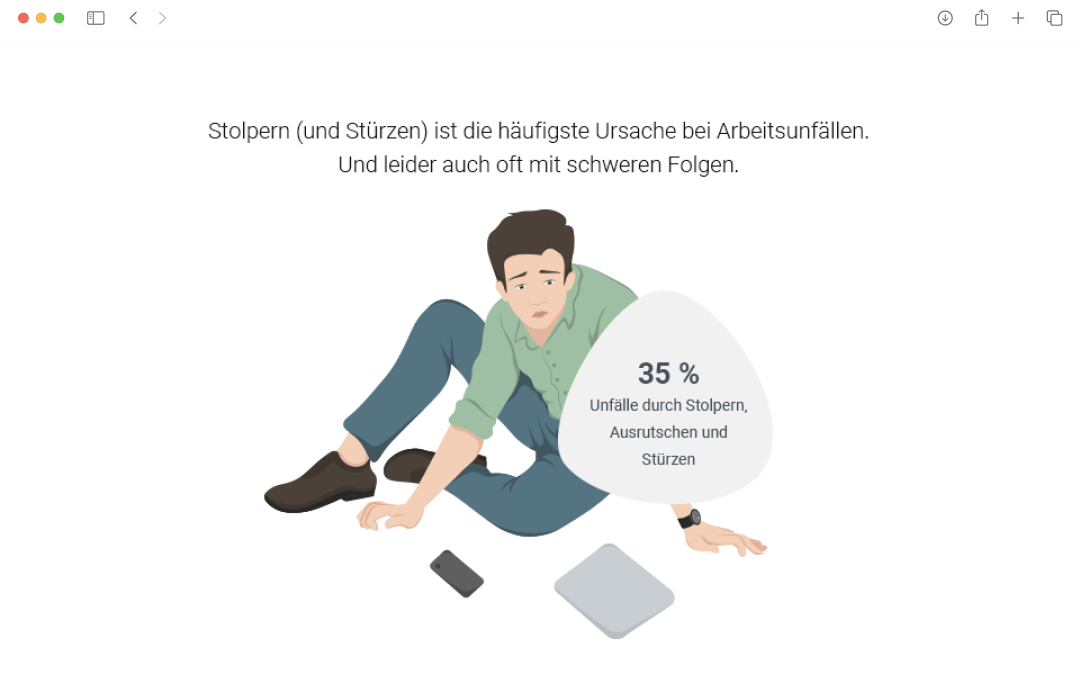
In 2023, around 838,000 reportable accidents at work were registered in Germany. Although the risk has decreased compared to previous years, people still have serious accidents - 499 employees died as a result of an accident at work in 2023.
The figures show: Occupational safety is essential. It is a system of risk assessments, measures, instructions and monitoring. Anyone who takes their duties seriously must ensure that employees understand what hazards they are exposed to, what protective measures apply and how to behave correctly on a day-to-day basis. This is not a "nice-to-have": The Occupational Health and Safety Act expressly obliges employers to instruct employees regularly and on an ad hoc basis.
If this knowledge is lacking, accidents happen not only "despite" regulations, but often because rules are unknown, misunderstood or perceived as being of little relevance.
Occupational health and safety is a matter for the boss - especially when it comes to mandatory training
Managers play a key role in occupational health and safety. They organise work, prioritise issues and define whether safety "runs along" or is actively designed. If they are not trained themselves, risk assessments, instructions or protective measures quickly become a mere formality.
However, managers in particular have a legal responsibility: they must ensure that requirements are implemented, employees are instructed and measures are monitored. Those who act out of ignorance not only risk accidents, but also personal liability and conflicts with supervisory authorities or accident insurance providers.
Occupational health and safety training should therefore not only focus on employees, but also specifically include managers and supervisors. Only when these groups know what is expected of them can occupational health and safety be consistently anchored in everyday life.
Discover our occupational health and safety training courses nowE-learning in occupational health and safety - what training should achieve
Good occupational health and safety training must combine two things: clear, understandable content and a form that fits into everyday working life. E-learning offers a strong option here in occupational health and safety.
The content of an occupational health and safety training course should
-
Explain the most important legal obligations and roles in the company,
-
make the relevant hazards concrete for the respective target group,
-
and clearly show what behaviour is expected in everyday life.
E-learning formats can support this particularly well because they are flexible in terms of time, work regardless of location and provide traceable documentation of who has completed which content - an important building block for fulfilling the training obligation.
If companies rely on immediately usable, legally certified e-learning modules, the effort required for conceptualisation, updating and legal assessment is reduced. At the same time, content should be updated regularly, as occupational health and safety is dynamic: new forms of work, new hazards and amended regulations mean that keeping up to date is a must.
Conclusion - occupational safety needs knowledge, not just regulations
The latest figures show: The legal basis for occupational health and safety is in place, but there are still gaps in knowledge in companies - both among employees and managers.
Anyone who takes occupational health and safety seriously must therefore take a two-pronged approach: On the one hand, create clear structures and responsibilities, and on the other, ensure that everyone involved knows what needs to be done. Training - and increasingly also e-learning solutions - are the key to turning duties into practice.
In short: occupational safety needs knowledge. And knowledge needs formats that work in everyday life.